
Last updated September 20, 2026
Free on-site gate assessment - hinges, posts, and your LiftMaster or Nice gate operator checked before anything is quoted
The assessment is free and the quote is the invoice.

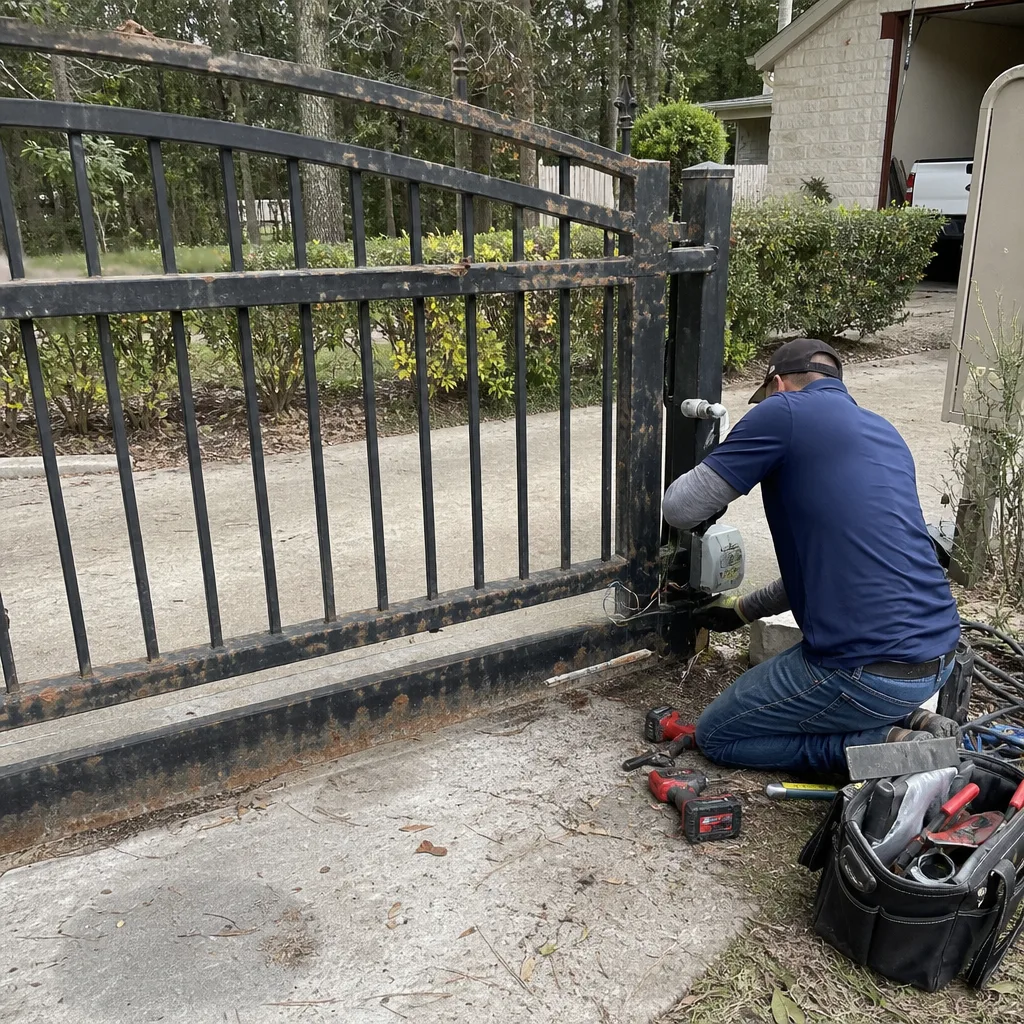 Before
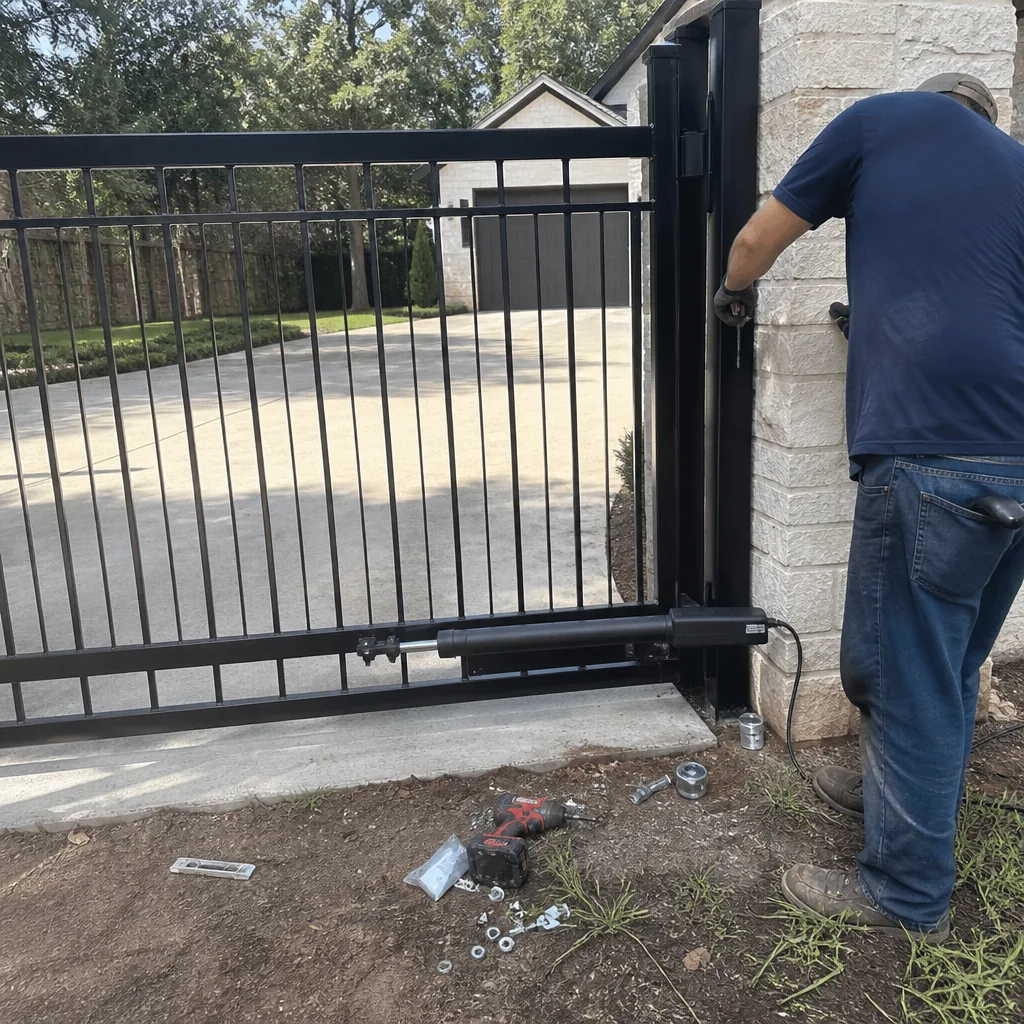 After
After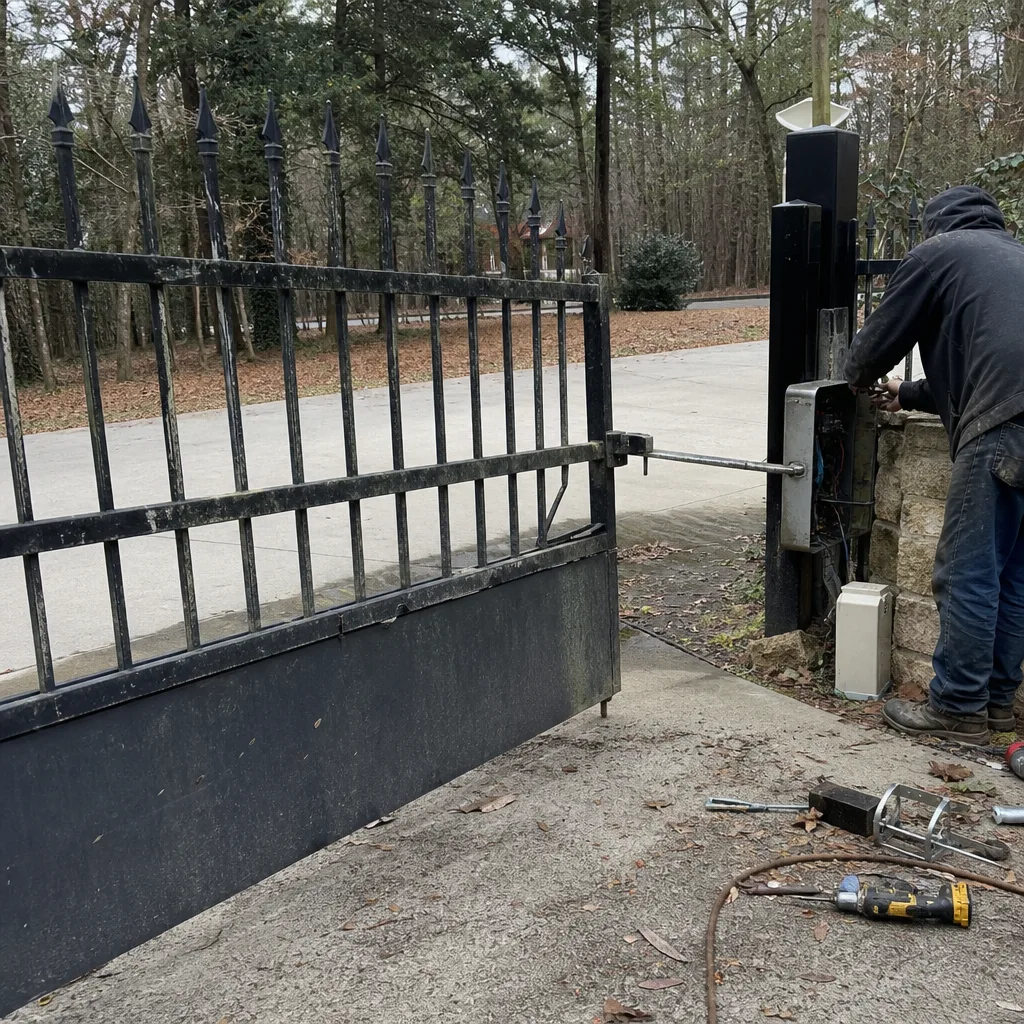 Before
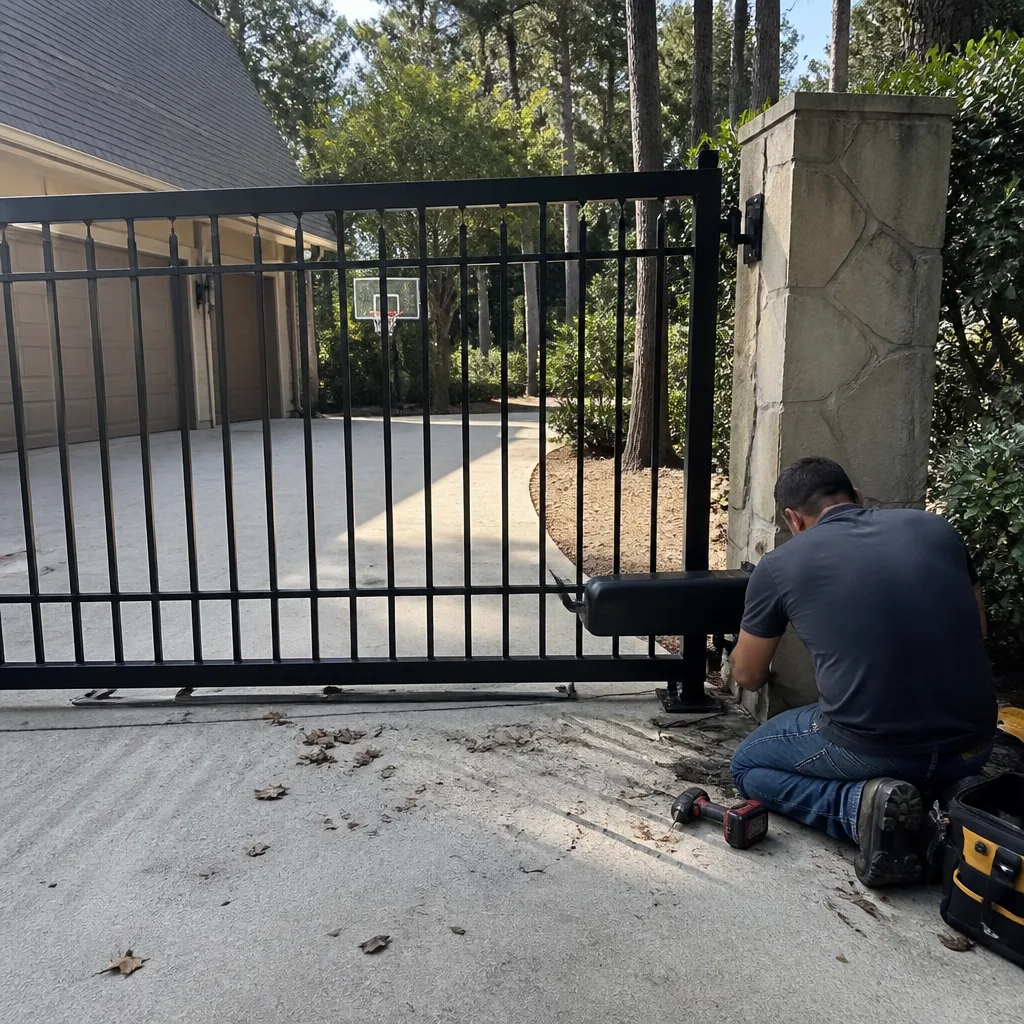 After
After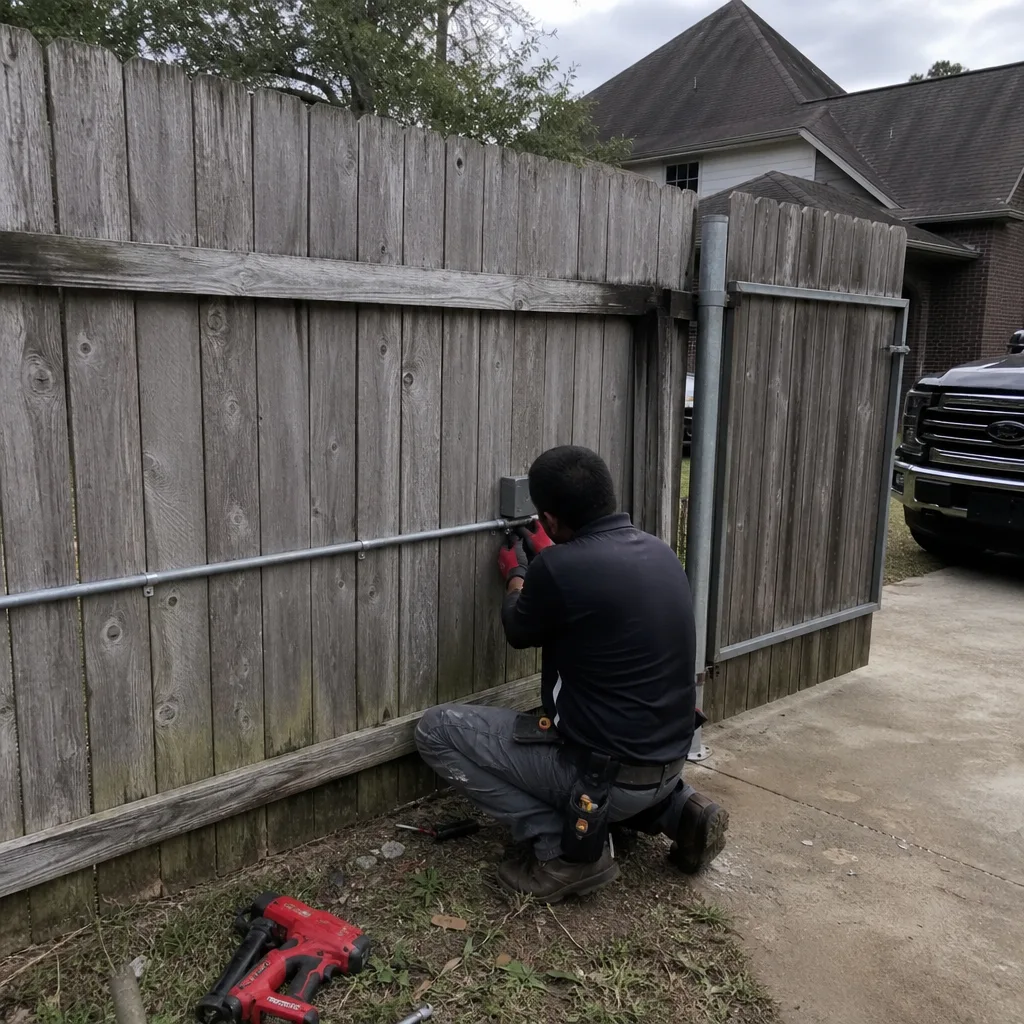 Before
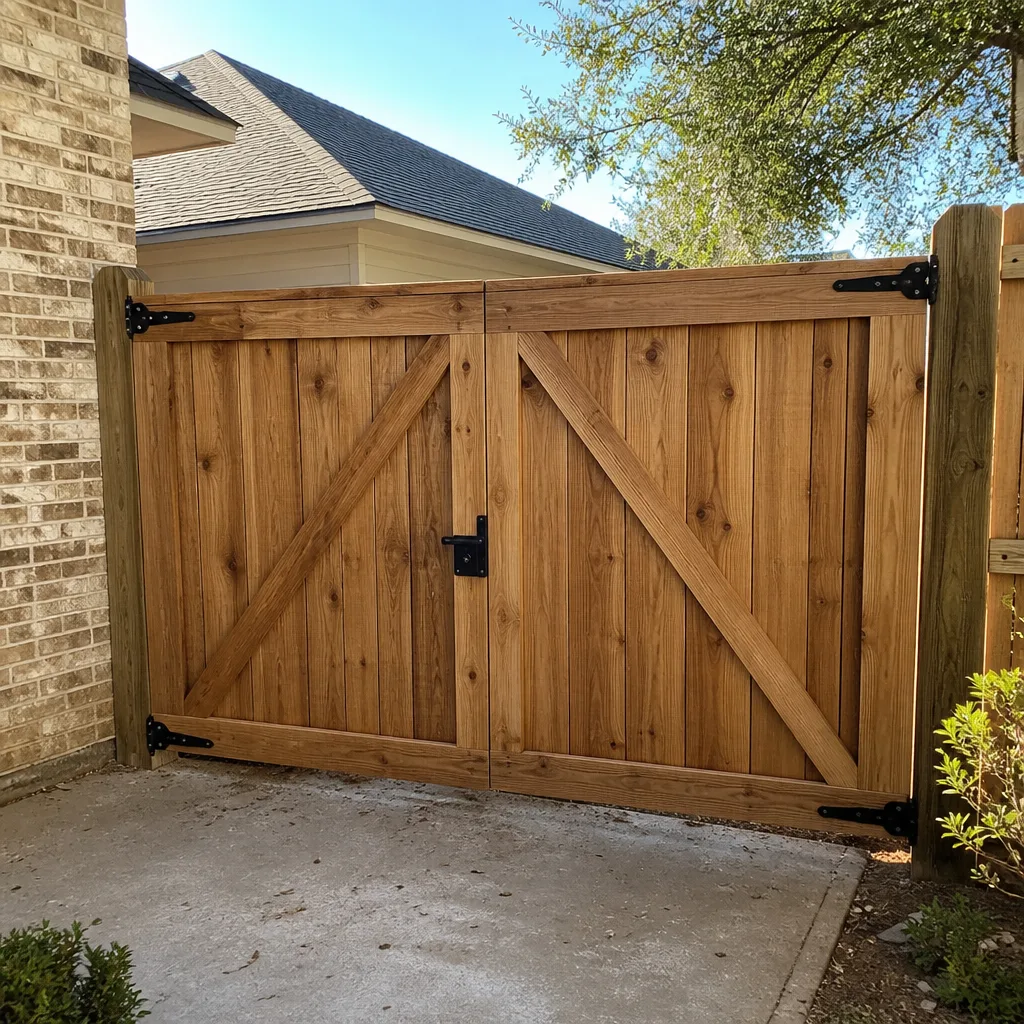 After
AfterGate Repair Warning Signs: A Conroe Homeowner’s Reference Guide
A gate that reverses mid-cycle isn’t just an annoyance. It’s the control board recording an obstacle or torque overload event, and every time you reset it and run the gate again without finding the cause, you’re shortening the motor’s remaining service life. Most Conroe homeowners don’t replace a gate motor because it suddenly died. They replace it because a small, correctable problem ran unattended for six months until the motor burned itself out trying to work against it. This gate repair guide separates the warning signs that mean schedule something soon from the ones that mean stop using the gate today. You’ll learn what specific sounds indicate which components, how to read a fault code on the three most common operators in Conroe, and the five-minute visual inspection that catches most failures before they become emergency calls.
Quick Answer
Gate repair warning signs fall into two categories: stop-using-today symptoms (grinding with visible metal shavings, a gate that reverses mid-cycle, a motor that hums but won’t move, a leaning gate post) and schedule-within-30-days symptoms (slower operation, two-button-press closing, minor sag, intermittent remote failure). A stop-using symptom means a component is failing under load and every additional cycle is causing more damage. A schedule symptom means the gate still operates safely, but the wear pattern is established and will not correct itself. In Conroe’s clay-heavy soil and humid climate, post movement and corrosion accelerate faster than homeowners expect, which is why a $200 hinge repair becomes a $1,400 motor replacement when the early signs are ignored.
Table of Contents
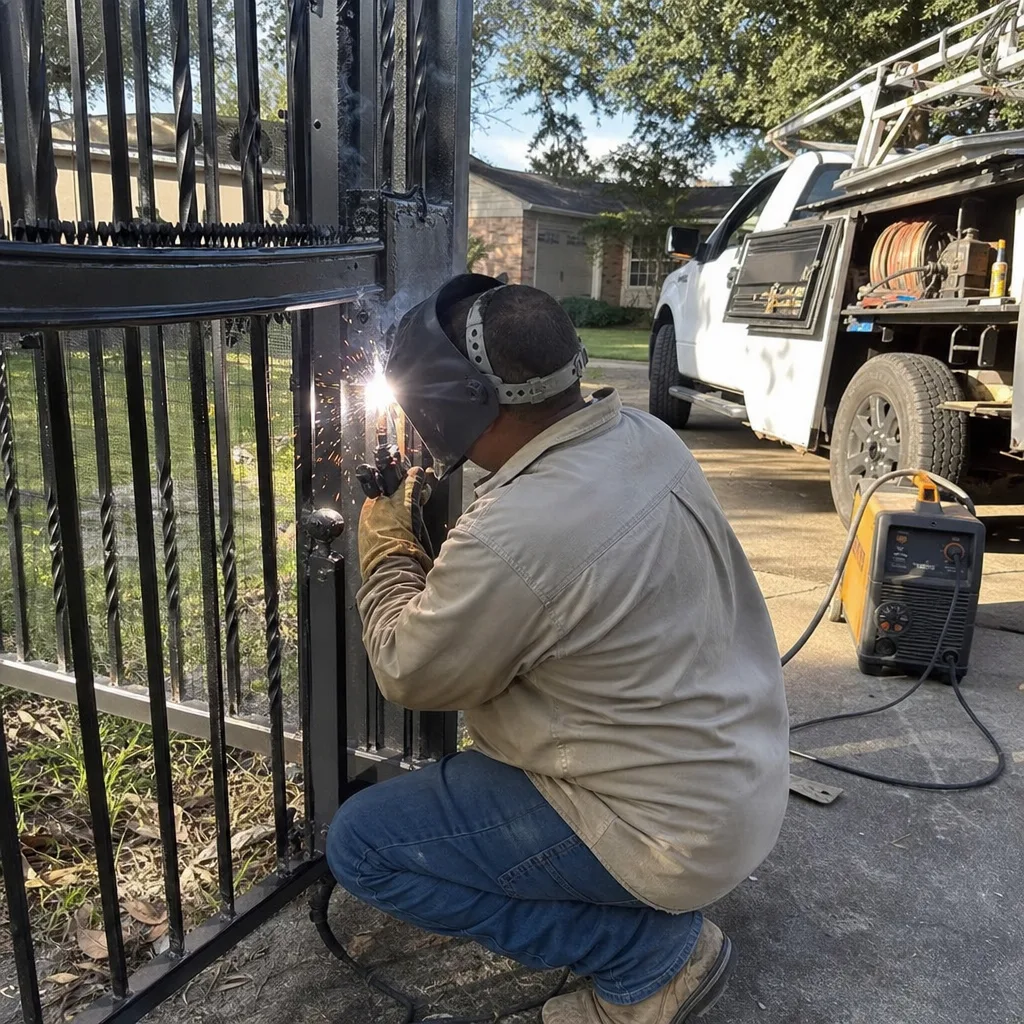
- Stop Using Now vs. Schedule Within 30 Days: The Two-Tier Warning Sign System
- What the Sound Tells You: Grinding, Clicking, and Humming Are Not Interchangeable
- How to Read a Fault Code on the Three Most Common Conroe Operators
- The Five-Minute Visual Inspection That Catches 80% of Developing Failures
- Why a Gate That Needs Two Button Presses Is Already in Failure Mode
- What Conroe’s Climate Does to Gate Hardware: Clay Soil, Humidity, and Storm Season
- What a Homeowner Can Safely Do, and What Should Never Be Touched
- Common Mistakes to Avoid
- When to Call a Professional
- Frequently Asked Questions
Before we get into the specific symptoms, a note on how we approach this. We’ve repaired gates in Conroe since 2014, and the pattern we see over and over is the same: a homeowner identifies the symptom correctly, but waits because the gate still works. Then a component fails completely, usually a motor or a control board, and a repair that would have been measured in hundreds of dollars becomes one measured in thousands. The Vance Gate Repair Conroe home page explains our approach in detail, but the short version is this: every warning sign below has a mechanical reason behind it. Once you understand the reason, the urgency makes sense.
BeforeAfterStop Using Now vs. Schedule Within 30 Days: The Two-Tier Warning Sign System
Most more guides & resources give you a list of symptoms with no priority attached. That’s the problem. A gate that makes a slight scraping sound and a gate that reverses mid-cycle are not equivalent warnings. One means you have weeks. The other means every additional cycle is actively destroying a component that would otherwise have survived. Here’s the two-tier system we use when we evaluate a gate in Conroe.
Stop Using Today: The Red-Flag Symptoms
These symptoms mean a component is failing under load. Continuing to operate the gate is not a neutral act. It’s compounding the damage. If you see any of these, secure the gate in the open or closed position and disconnect power to the operator until a technician can inspect it.
- Visible metal shavings or powder at the hinge or wheel track. This means metal-on-metal contact without lubrication, and the wear surface is being ground away. Every cycle removes more material until the hinge pin shears or the wheel seizes.
- The gate reverses mid-cycle every time it closes. The control board is detecting an obstacle or torque overload. It may be a misaligned photo-eye, but if it’s a torque issue, the motor is pulling more amperage than it’s rated for, and heat is building in the windings.
- The motor hums but the gate does not move. The capacitor may have failed, or the gearbox is bound. Either way, a humming motor with no movement means full current is flowing through a stationary rotor. Heat builds fast. This is how motors cook themselves.
- A leaning gate post or a gate that drags on the ground. The foundation is shifting, usually from Conroe’s expansive clay soil cycling through wet and dry seasons. A dragging gate adds load to the motor, and the motor compensates by pulling more current. It’s a slow-burn motor killer.
- Burning smell from the operator housing. That’s insulation inside the motor or control board reaching thermal breakdown. Shut it down. The next stage is a component fire inside the housing, and while residential operators have thermal protection, relying on it is not a maintenance strategy.
Schedule Within 30 Days: The Yellow-Flag Symptoms
These symptoms mean the gate still functions safely, but a wear pattern is established and will not reverse itself. You have a window measured in weeks, not days, to address the cause before it migrates into the red-flag tier.
- The gate moves noticeably slower than it used to. A swing gate operator that takes four extra seconds to complete its travel is usually working against increased resistance. That resistance comes from hinge wear, low hydraulic fluid (if applicable), or the beginning stages of post settlement.
- It takes two button presses to close the gate. We’ll go deeper on this below, but in short: the first press is being consumed by a safety circuit that’s not resetting properly. The control board is telling you something. Ignoring it means you’ll eventually get zero presses that work.
- The gate sags visibly when fully open. The hinge pins or the post bracket are wearing. A sagging gate loads the top hinge unevenly, which accelerates the wear. Caught early, this is a hinge replacement. Caught late, it’s a post replacement and a gate re-hang.
- The remote works intermittently or only at short range. This could be a failing receiver board in the operator, a dying remote battery, or, in some Conroe neighborhoods, RF interference from nearby electrical infrastructure. If new batteries don’t fix it, the receiver is the likely culprit.
- Small rust blooms at welds or bolt heads. Conroe’s humidity makes surface rust a fact of life, but rust at a weld or a high-stress connection point indicates the protective coating has failed where it matters most. Wire brushing and touching up a small rust bloom in year three prevents structural replacement in year seven.
What the Sound Tells You: Grinding, Clicking, and Humming Are Not Interchangeable
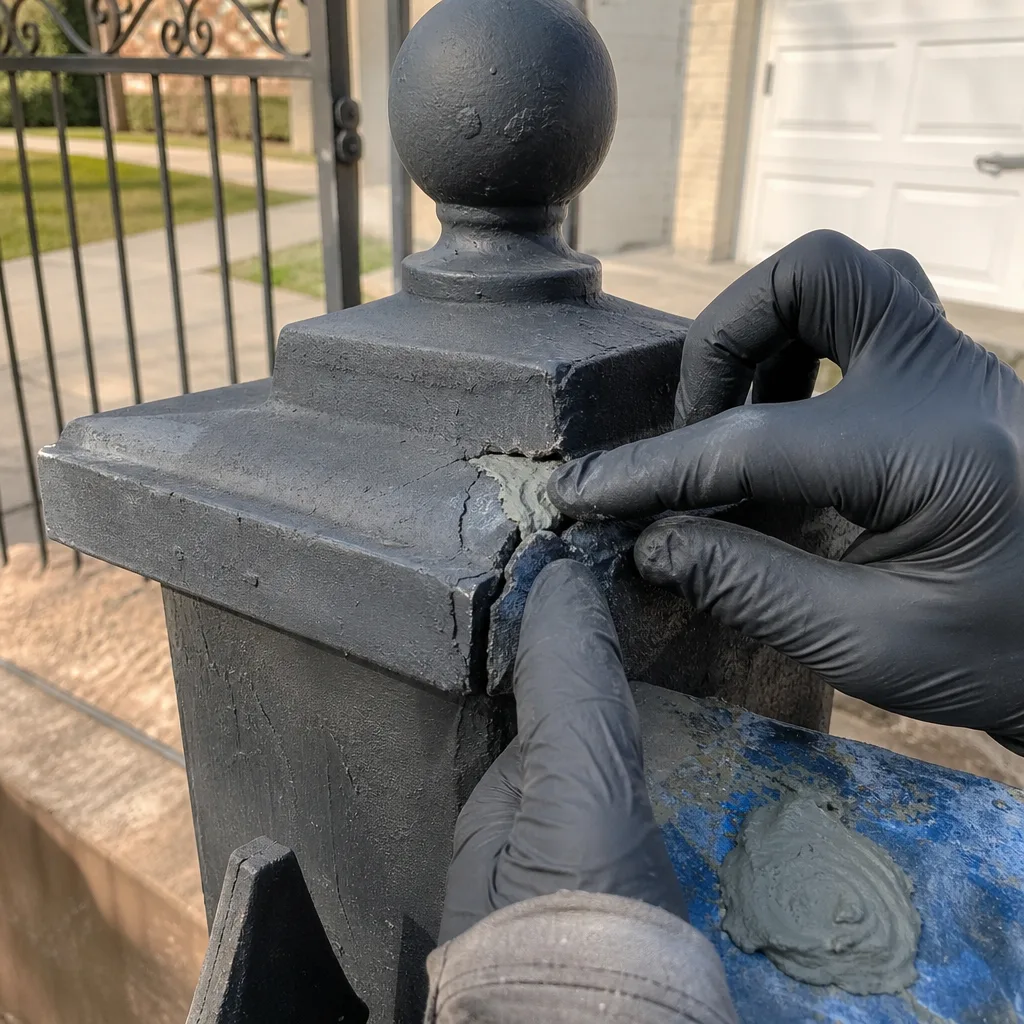
Sound is the most underused diagnostic tool on a residential gate. The sound a gate makes is not random noise. It’s a component communicating its condition. Here’s what we listen for when we’re called to a gate in Conroe, and what each sound means.
Grinding: Metal on Metal, No Lubrication
Grinding is a coarse, scraping sound that happens while the gate is moving. It means two metal surfaces are in contact without a lubricant film or a bearing between them. The most common source on a swing gate is a dry hinge pin that has been dry long enough to wear the hinge barrel out of round. On a sliding gate, grinding usually comes from a wheel bearing that has failed and is now running on the inner race, or from the chain dragging on the rack. The fix for a dry hinge is lubrication, but only if it’s caught before the barrel is wallowed out. If the grinding has been going on for weeks, the hinge is usually beyond saving, and lubrication will only quiet the symptom while the underlying wear continues.
Clicking: An Electrical Relay or a Failing Capacitor
A repeated clicking sound when the remote is pressed, with no gate movement, is the operator’s relay engaging and disengaging. On a Linear or Viking operator, this often means the start capacitor has failed. The capacitor provides the initial torque burst to get the motor spinning. If the capacitor is dead, the relay clicks, the motor tries to start, the thermal protection circuits see the locked rotor current, and the relay drops out. That cycle repeats until the homeowner stops pressing the button. A single click when the gate starts or stops moving, however, is usually just the limit switch or a solenoid engaging, and that’s normal. The diagnosis boils down to repetition: one click is a switch, repeated clicking is a failed start component.
Humming but No Movement: The Most Urgent Sound of All
As noted in the red-flag section, a motor that hums but does not turn is in a stalled condition. Full current flows through the windings, creating heat that breaks down the winding insulation. The cause is usually a seized gearbox, a bound gate wheel, or a failed run capacitor on capacitor-start motors. Every second the motor sits in this state shortens its life. If you hear a humming operator and the gate is not moving, disconnect power at the breaker or unplug the operator before you do anything else. A stalled motor will survive a few minutes of curiosity. It will not survive a weekend of the homeowner occasionally pressing the button to see if it started working again.
We carry a decibel meter on every service call, not because we need it, but because a documented sound reading gives us a baseline. If we measure 72 decibels at the operator during a normal open cycle on the day we replace a hinge, and then measure 85 decibels six months later, something changed even if the gate still works. That’s the kind of documentation habit we developed working commercial access control, and we bring it to every residential job in Conroe.
How to Read a Fault Code on the Three Most Common Conroe Operators
Most modern gate operators have a diagnostic display or an LED that flashes a pattern to indicate a fault condition. The homeowner’s manual gives you the code table, but many Conroe homeowners have inherited a gate from a previous owner and have no manual. Here’s what we see most often, and what the codes mean in plain language.
LiftMaster and DoorKing Style: Blinking LED Codes
LiftMaster operators used on the majority of Conroe residential gates report faults through a flashing LED on the control board or a diagnostic display on newer models. The most common code we see is a repeated double-flash, which on most LiftMaster models indicates a photo-eye obstruction or misalignment. A single flash often means a force reversal was triggered, which means the gate hit something or pulled too much current. If the LED is solid and the gate doesn’t move, the board is in a lockout state, usually triggered by three consecutive force reversals. The fix is to clear the obstruction or correct the alignment, then reset the board by removing power for 30 seconds. If the gate still won’t move after a reset, the force settings themselves are likely misadjusted, and that’s a technician-level job.
DoorKing boards use a similar LED system but with different timing. A DoorKing board with a rapidly flashing red LED is typically reporting a “soft start failed” condition, which means the motor tried to ramp up but couldn’t. That points to a capacitor problem or a mechanical bind. A slow, steady flash pattern usually indicates a loop detector fault or a phantom signal from a vehicle loop, which is more common in Conroe subdivisions where multiple houses share a utility easement and underground wiring runs parallel to the loop leads.
Ghost Controls: The Beep and Flash Pattern
Ghost Controls operators, which are common on smaller residential gates in Conroe, report faults differently. The operator emits a series of beeps, and the number of beeps corresponds to a specific condition. Two beeps usually indicates the gate encountered an obstacle. Four beeps means a motor overload condition was detected and the board has shut down to protect the motor. Six beeps on most Ghost Controls models indicates a low battery condition on the battery-backup models. The manufacturer’s code table is different by model year, so if you don’t have the manual, note the exact beep pattern and the model number from the label on the operator, and we can usually identify the fault over the phone before we dispatch.
One thing we always remind Conroe homeowners: a fault code is a symptom report, not a diagnosis. A force-reversal code tells you the gate met more resistance than expected. It does not tell you whether the resistance came from a bad hinge, a low battery on a solar operator, or a tree root lifting the track. Clearing the code without finding the cause is the residential equivalent of pulling the battery out of a smoke detector because it’s beeping. The beep isn’t the problem.
The Five-Minute Visual Inspection That Catches 80% of Developing Failures
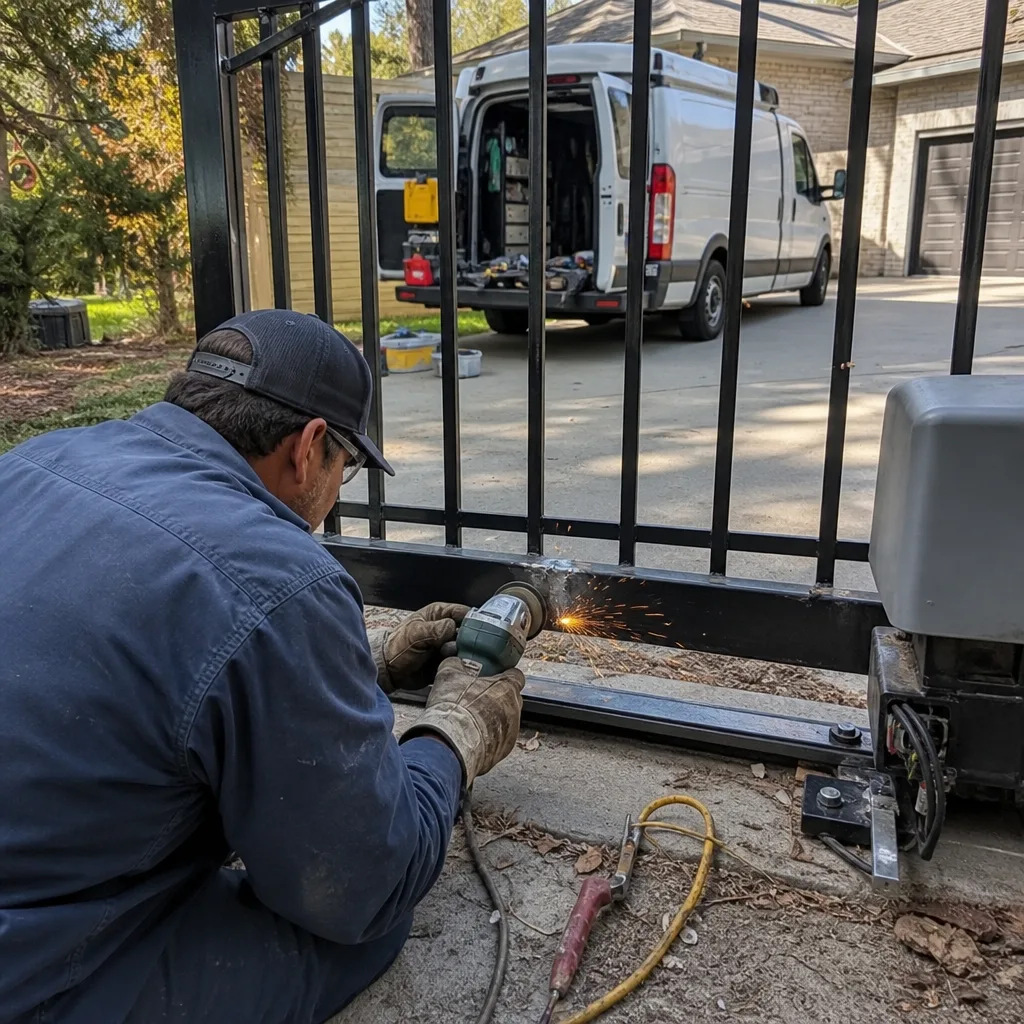
You don’t need a multimeter or a service manual to catch most gate problems before they become emergencies. You need five minutes, a flashlight, and a willingness to look at the parts of the gate that aren’t the pretty ornamental face. Here’s the sequence we recommend, in order.
- Look at the hinges first. On a swing gate, check the hinge pins for rust dust, scoring, or visible play. Push the gate at the latch end and watch the hinges. Any movement at the pin means the hinge barrel is wearing. On a sliding gate, check the wheel bearings the same way: lift slightly on the gate and feel for play.
- Run your eyes along the bottom edge of the gate. You’re looking for scrapes on concrete, dragged gravel lines, or uneven wear. In Conroe, a gate that scraped cleanly in January may drag heavily in July if the post has shifted through a wet-dry clay cycle, and the wear pattern will show it.
- Check the photo-eyes. The photo-eye is the small infrared sensor on either side of the gate opening, mounted at the height where a car bumper would cross. Look for spider webs, dirt, or grass that has grown up in front of the lens. Misalignment is also common; if you see a red or flashing indicator LED on one eye, it’s usually not aligned with its partner.
- Open the operator cover. With power disconnected, remove the cover and look for evidence: burned insulation smell, swollen capacitor, insects, moisture, or corrosion on the board. Conroe’s humidity means condensation inside the operator housing is common; look for any sign it has been collecting.
- Check the chain or belt tension on sliding gates. A chain that sags more than an inch at mid-span is loading the sprocket unevenly. A belt that’s too tight loads the motor bearings. Most homeowners can see the issue, and the correction is a technician adjusting the tensioner, not a replacement.
That entire sequence takes less than five minutes, and it catches the majority of developing failures we find on service calls in Conroe. The reason it works is that almost every gate failure leaves a physical trace before it leaves a functional one. Metal shavings appear before the hinge fails. The bottom-edge scrape appears before the motor burns out. The swollen capacitor appears before the board gives up. The trace is there if you look for it.
Why a Gate That Needs Two Button Presses Is Already in Failure Mode
This is the warning sign that most Conroe homeowners dismiss, and it’s also the one we can explain most precisely. A gate that opens on the first press but needs a second press to close is not a quirky gate. It’s a gate in the early stages of a safety circuit failure.
Here’s what’s happening mechanically. On most residential operators, the close cycle is gated behind a safety check. The control board checks the photo-eyes, the edge sensors, and the current draw on the motor before it will initiate a close. If any of those checks returns a value outside the expected range, the board aborts the close command. On a wired keypad or push button, the homeowner experiences this as pressing the button and nothing happening. On a remote, it’s the same: first press closes the circuit but the board refuses the command, second press completes the close because by then a safety input has settled back into range.
The reason this matters is that the board is actively rejecting commands based on an input it doesn’t trust. That input is almost always a photo-eye that’s drifting out of alignment, a low-voltage condition on the safety circuit, or a force-sensing circuit that’s seeing borderline current values during the open cycle and carrying that reservation into the close command. None of these conditions improve with time. The photo-eye drifts further. The low-voltage condition worsens as a connection corrodes, especially in Conroe’s humid air. The force readings stay borderline because the underlying mechanical resistance never gets addressed.
Every two-press close is the control board doing its job and telling you it doesn’t like something. The fix is usually a $75 to $150 alignment or connection repair. The consequence of ignoring it is a board that eventually locks out the close cycle entirely, or a motor that has been running against increasing resistance for months. We’ve replaced boards that would have been saved by a photo-eye alignment done in the first month the two-press symptom appeared.
What Conroe’s Climate Does to Gate Hardware: Clay Soil, Humidity, and Storm Season
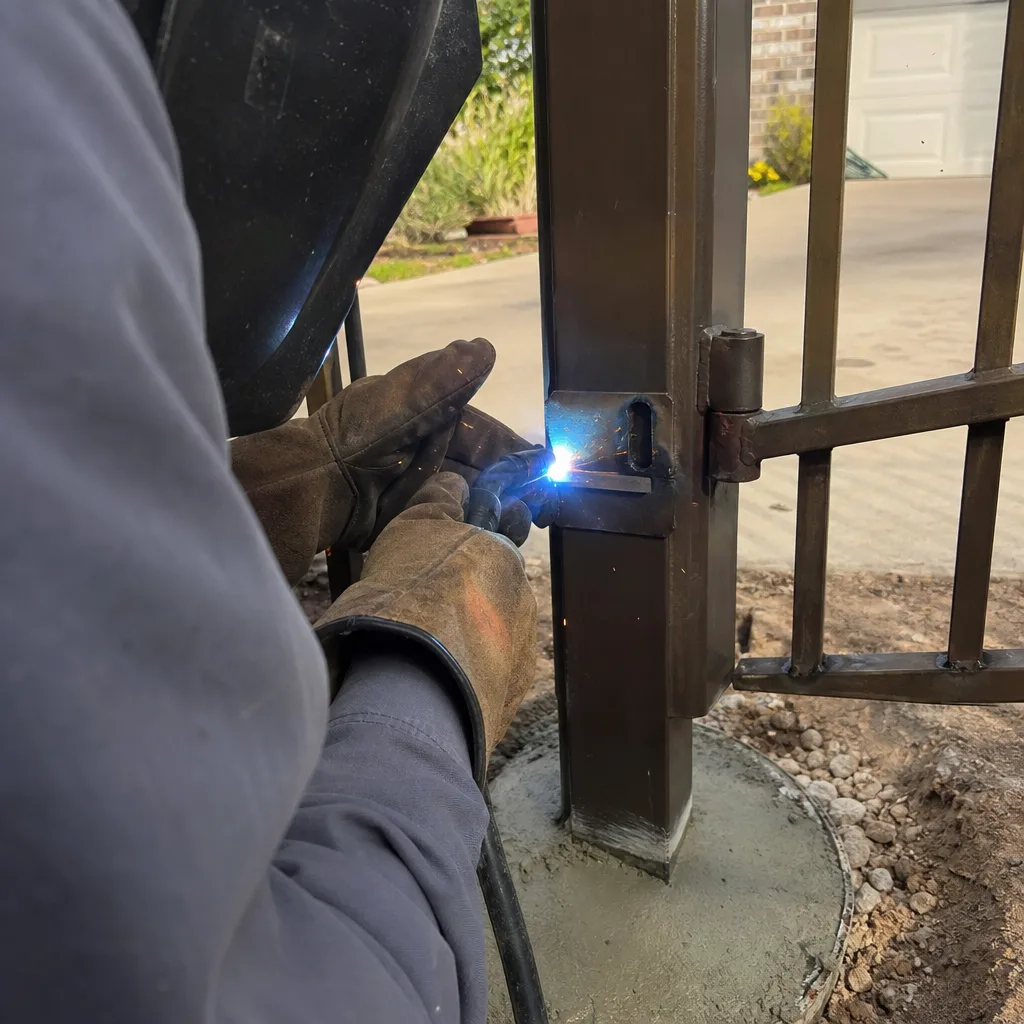
Conroe’s geography creates specific failure patterns that a generic gate guide won’t tell you about. The most significant is the soil. Much of Conroe and Montgomery County sits on expansive clay that swells when wet and shrinks when dry. The swing from a wet spring to a dry August can lift and drop gate posts through a cycle of a quarter inch or more. Over years, that movement works the post out of true and transfers uneven load to the gate. The gate sags. The sag loads the hinges. The loaded hinges wear. The motor works harder. That’s the failure chain that ends with a motor replacement that could have been a post re-set if caught in the first cycle.
Humidity is the second factor. The air in Conroe holds enough moisture that condensation forms inside operator housings overnight, especially during the shoulder seasons when temperatures swing from warm days to cool nights. That condensation settles on control boards and terminals. Over time, terminal corrosion creates resistance, which creates heat, which creates failed connections. We recommend every Conroe homeowner open their operator cover once a season and look for moisture beading, but the permanent fix is a properly sealed housing and dielectric grease on the terminals, which we apply on every gate motor and opener service call in Conroe.
Storm season adds the third variable. Lightning strikes don’t need to hit the gate to damage it. A strike on the power grid a mile away can send a voltage spike through the operator’s power supply and take out the control board. Every operator we install in Conroe gets a surge suppressor at the disconnect, and every repair includes a check of the ground path. That’s not optional in a region that sees the storm activity Montgomery County does. It’s the difference between a gate that survives the next storm season and one that doesn’t.
What a Homeowner Can Safely Do, and What Should Never Be Touched
A gate is a machine that moves a heavy object through a path that people and vehicles cross. Some maintenance tasks are safe for any homeowner. Others are not. The distinction matters because the parts that injure people are exactly the parts that look the most approachable.
Safe to Do Yourself
- Cleaning photo-eye lenses with a soft cloth and mild glass cleaner. Misalignment adjustment is fine if you’re comfortable watching the indicator LED to confirm alignment.
- Lubricating hinges with a spray lithium grease or white lithium, using the straw to get oil into the hinge pin contact area.
- Tightening visible bolts on the gate frame, brackets, and operator mounting plate, provided you can access them without removing safety covers.
- Trimming vegetation that has grown into the gate path or in front of photo-eyes.
- Running the visual inspection sequence from the section above and documenting what you find with photos.
Do Not Attempt Without a Trained Technician
We say this from experience, not from liability aversion. The two components on a gate that store mechanical energy in a way that can release suddenly are the torsion spring on some swing gates and the tensioned chain or belt on sliding gates. If a torsion spring lets go, the stored energy releases through the mounting bracket and the gate arm, and anything in that path takes the full force. The tension on a sliding gate chain is similarly unforgiving; a chain that comes off its sprocket under tension can whip. We never recommend a homeowner tension or release either of these components. The risk is not worth the savings on a service call. The same applies to any work inside an operator housing while power is connected. If the breaker isn’t off and verified with a non-contact voltage tester, the housing stays closed.
For the record, our gate repair service in Conroe includes full documentation of everything we touch: before photos, after photos, and a written record of the part numbers installed and the settings we changed. If you do the safe homeowner-scale maintenance yourself, you’re working with the same documentation habit we use, just at a smaller scale. That’s the right way to work on a gate: observe, document, then act. The observation always comes first.
Common Mistakes to Avoid
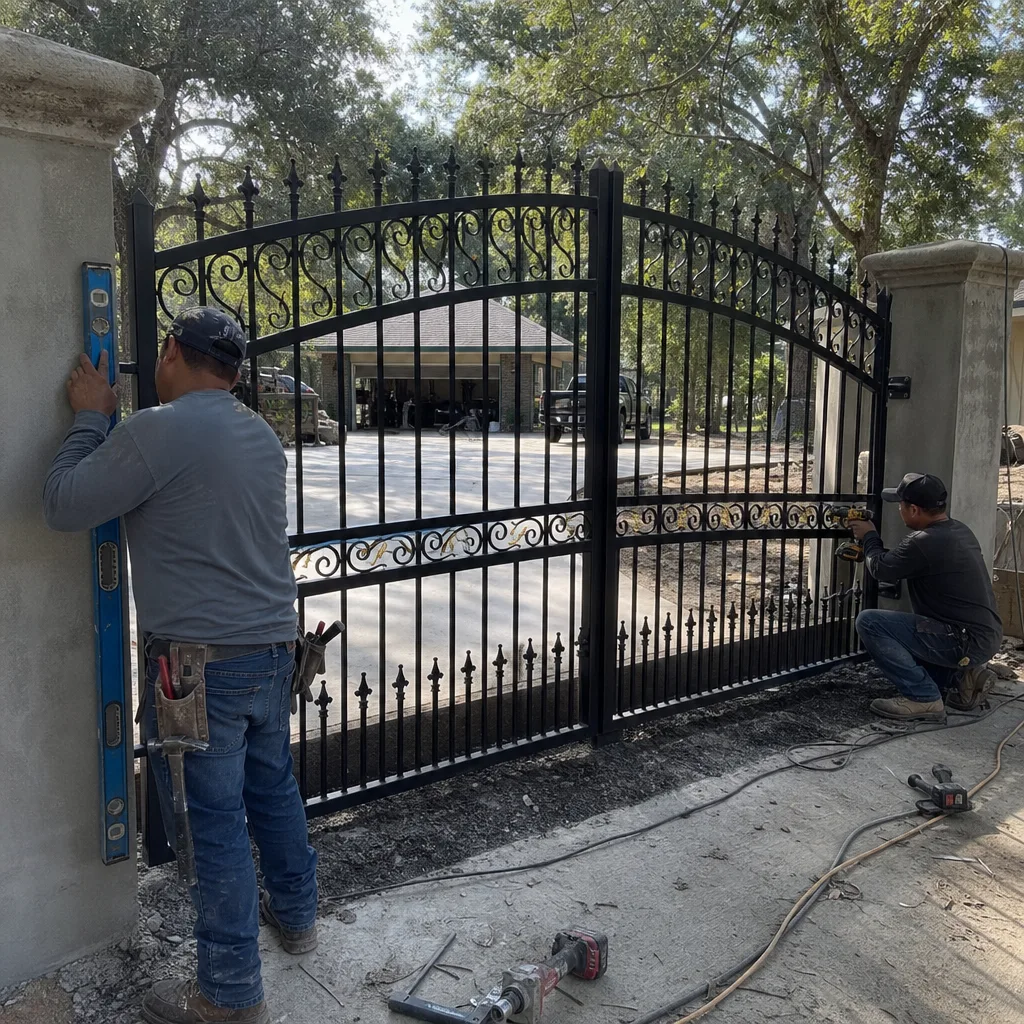
- Resetting a fault code without addressing the cause. The board will lock out again, but the second time it happens, the component that triggered the fault has worn further. Clearing a code and pressing the button is not repair. It’s a postponement with interest.
- Lubricating a hinge that’s already failed. If the hinge barrel is wallowed out, adding grease makes the sound go away for a week and keeps you from seeing the real problem. We’ve had Conroe customers lubricate a grinding hinge into silence, then call us three months later when the gate fell off the top hinge.
- Considering warning signs as separate issues rather than one connected failure. A sagging gate and an overheating motor are the same problem at two different points on the chain. Fix the sag and the motor stops overworking. Replace the motor and leave the sag, and you’ll buy another motor.
- Waiting to see if a sound goes away. Gate sounds do not heal. A grinding hinge grinds until it fails. A clicking relay clicks until the capacitor fails completely. The only thing that changes with time is the size of the invoice.
- Treating a gate the same as an appliance. You don’t inspect a refrigerator motor twice a year because it’s designed to run for fifteen years untouched. A gate is different: it sits outdoors, moves a heavy load through weather, and depends on sensors and safety circuits. It needs the same kind of attention you’d give a vehicle if the vehicle sat in the driveway in Conroe humidity for a decade.
- Assuming a new motor fixes everything. The motor is rarely the root cause. It’s usually the last component in a chain that failed. If a technician replaces the motor without addressing the hinge wear or the post settlement that caused the overload, the new motor lives a shortened life.
When to Call a Professional
Any symptom in the red-flag tier from the section above means the gate should be secured and a professional should be called before the next cycle. Any symptom in the yellow-flag tier that has persisted beyond a couple of weeks has moved past the point of homeowner-level correction. And any gate that has tripped a breaker more than once is reporting an electrical fault that will not resolve itself. You’ve done the documentation. You’ve found the symptom. Now it’s a question of who corrects it. Vance Gate Repair Conroe offers free estimates in Conroe, and every estimate is a written price handed to you before any work starts. Call (936) 297-5126 and we’ll send a technician who will show you what they found, in photos, before they touch anything.
Frequently Asked Questions
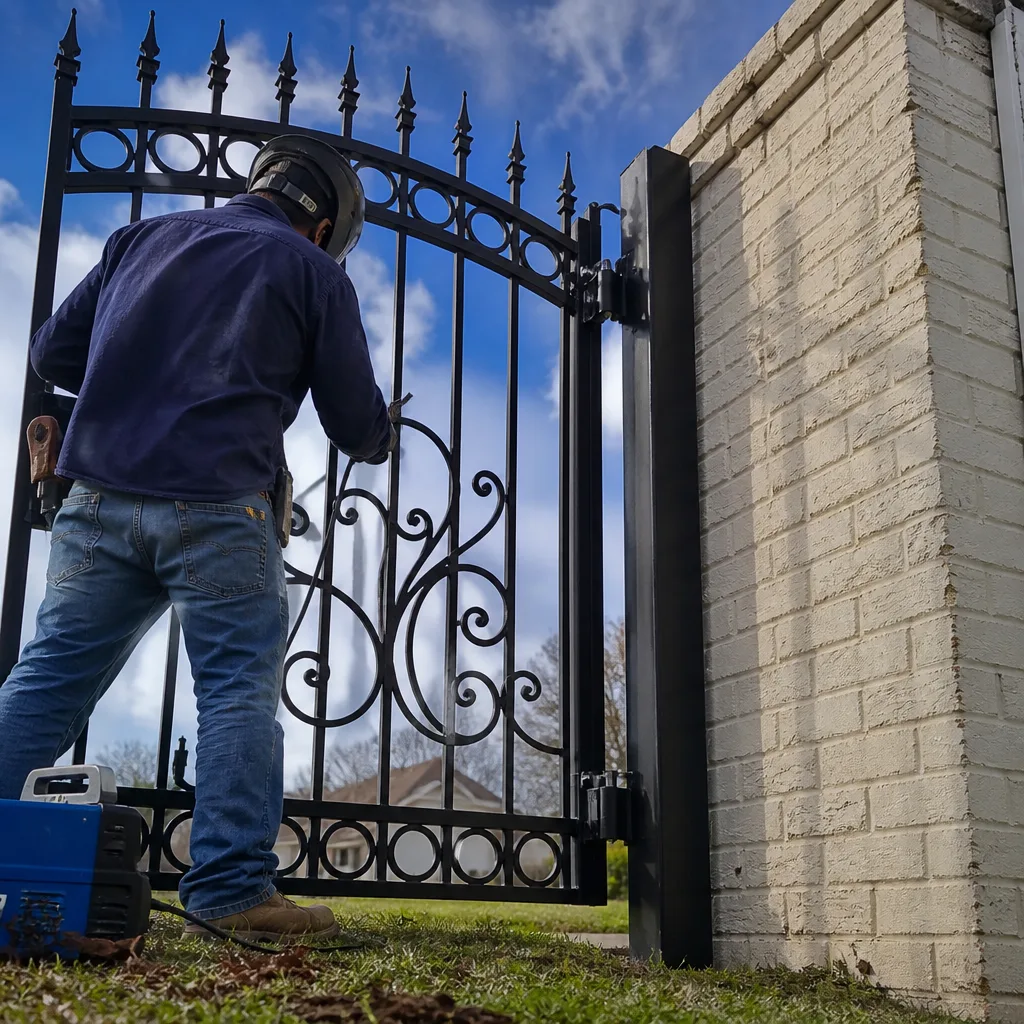
Most gate repairs in Conroe run between $150 and $600, depending on whether the fix is a component repair like a photo-eye alignment or a replacement like a hinge or a control board. A swing gate hinge replacement typically runs $150 to $300. A control board replacement on a LiftMaster or DoorKing operator typically runs $350 to $700 depending on the model. A full operator replacement, which is usually only needed when a motor has burned out from prolonged overload, runs $800 to $1,400 installed. Every one of those prices is quoted in writing before we start, and under Haven Standard Clause 1, the flat price is handed to you before any work begins. Call (936) 297-5126 for an exact quote on your gate, and you’ll have the number in hand before you commit to anything.
Yes. We run repair service in Conroe every day, and we prioritize red-flag symptoms: gates that won’t close at all, gates stuck open, motors that hum and don’t move, and any condition that leaves a property unsecured. A live person answers the phone 24 hours a day, seven days a week, not a voicemail system. If your gate is doing something on the red-flag list, call (936) 297-5126 now and we’ll get a technician headed your way.
In our experience, the single most common repair in Conroe is a hinge replacement on a swing gate, usually caused by post settlement in the clay soil combined with years of operation on a hinge that was never re-lubricated after installation, as covered in our How to Hire a Gate Repair Contractor in Conroe: A Step-by-Step Guide. The second most common is a photo-eye misalignment that started as a two-button-press symptom and progressed to a full system lockout. Both are fully correctable with the right parts and settings, and both are typically $300 or less when caught early.
An electric gate motor usually gives three warnings before failing: the gate slows down even with no visible obstruction, the gate reverses mid-cycle or fails to close on first press, and the operator emits a burning smell or a loud hum without movement. In Conroe’s climate, condensation inside the operator housing can accelerate the corrosion that causes these warnings, so if you see any of these symptoms, the timeframe to act is shorter here than in drier regions.
On a Ghost Controls operator, continuous beeping with no movement usually indicates a fault lockout condition after an obstacle or overload event, or a low battery on the battery-backup model. On Linear or Viking operators, the beeping is often a fault code signal from the control board. The specific beep pattern identifies the fault. Count it, note it, and call us at (936) 297-5126; we can usually identify the fault from the pattern and the model number before we even dispatch.
We recommend a full inspection and lubrication once a year in Conroe, with the visual inspection sequence in this guide done by the homeowner once a season, as outlined in our Seasonal Gate Repair Care for Conroe: Year-Round Homeowner’s Guide. Conroe’s climate accelerates wear: the clay soil shifts posts, the humidity corrodes connections, and the summer heat stresses capacitor lifespan. A gate that gets professional attention once a year will typically last two to three times as long as a gate that only sees a technician when it stops working.
We service nine major gate-automation brands: LiftMaster, FAAC, BFT, Linear, Viking, Ghost Controls, DoorKing, Elite, and Mighty Mule. That means when we show up to diagnose your gate, we work on whatever motor is already on the property. We don’t steer Conroe homeowners toward a replacement operator unless the existing one has genuinely reached the end of its service life and the repair cost exceeds the replacement value.
Our service area covers Conroe and the surrounding Montgomery County communities. We also handle gate installation across the broader region. If you’re wondering whether we work in your neighborhood, call (936) 297-5126 and ask. If we can’t get to you, we’ll tell you that directly and recommend who can. We’d rather give you a straight answer than waste your time.
The Bottom Line
A gate is the only machine on a Conroe property that combines a heavy moving mass, an electric motor, safety sensors, and direct exposure to Montgomery County’s clay soil and humidity, and it’s expected to work flawlessly for a decade or more. It won’t do that on its own. The warning signs this guide covers are all visible or audible before the failure happens. Grinding means metal is losing material. Clicking means a capacitor or relay is struggling. Two button presses means the board is rejecting a command based on a bad input. None of these correct themselves. All of them are cheaper to fix than the failure they predict. The difference between a $200 hinge repair and a $1,400 motor replacement in Conroe is not luck. It’s attention, and timing, and the willingness to act on what you see and hear before the gate gives up entirely. If you’ve noticed something, write it down. Then call us at (936) 297-5126, and we’ll give you a written price and a documented record of everything we find.
Written by Adrian Vance, Owner at Vance Gate Repair Conroe, serving Conroe since 2014.