
Last updated September 20, 2026
Free on-site gate assessment - hinges, posts, and your LiftMaster or Nice gate operator checked before anything is quoted
The assessment is free and the quote is the invoice.


 Before
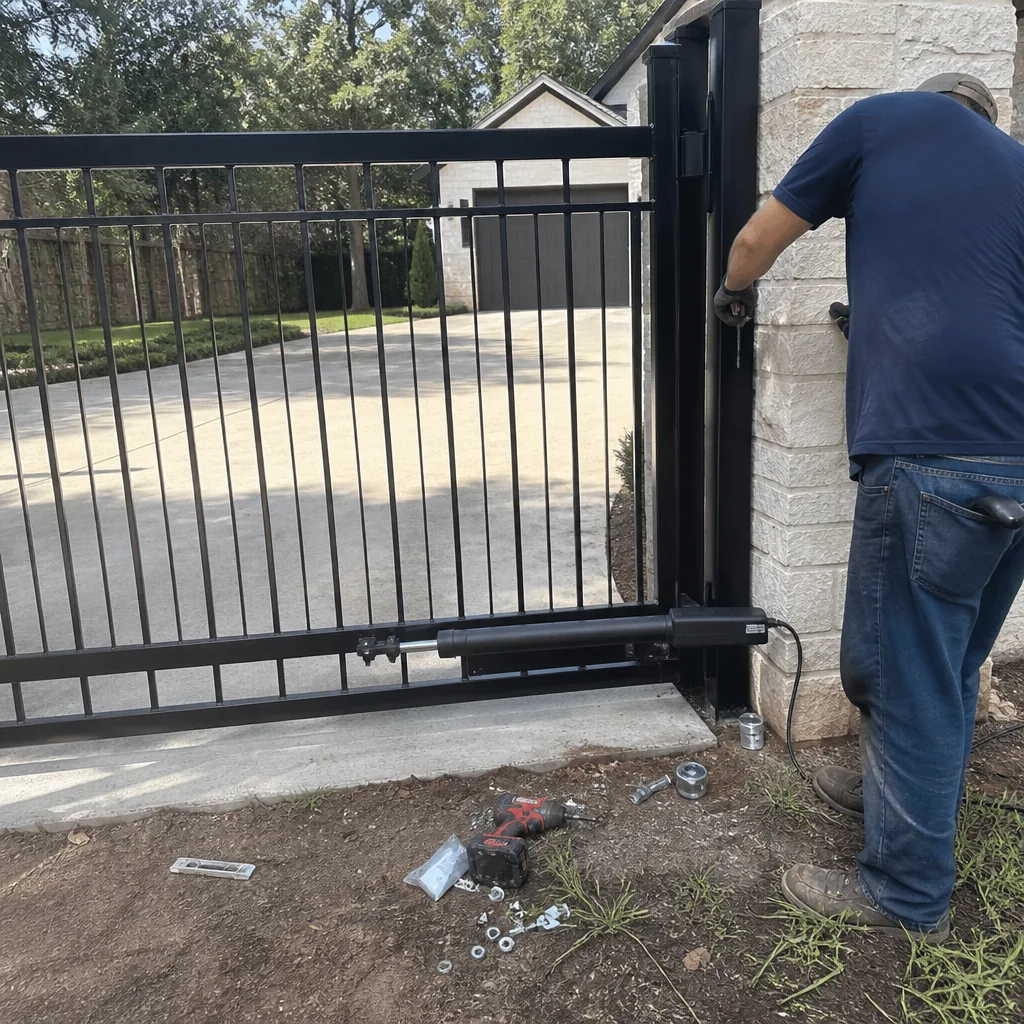 After
After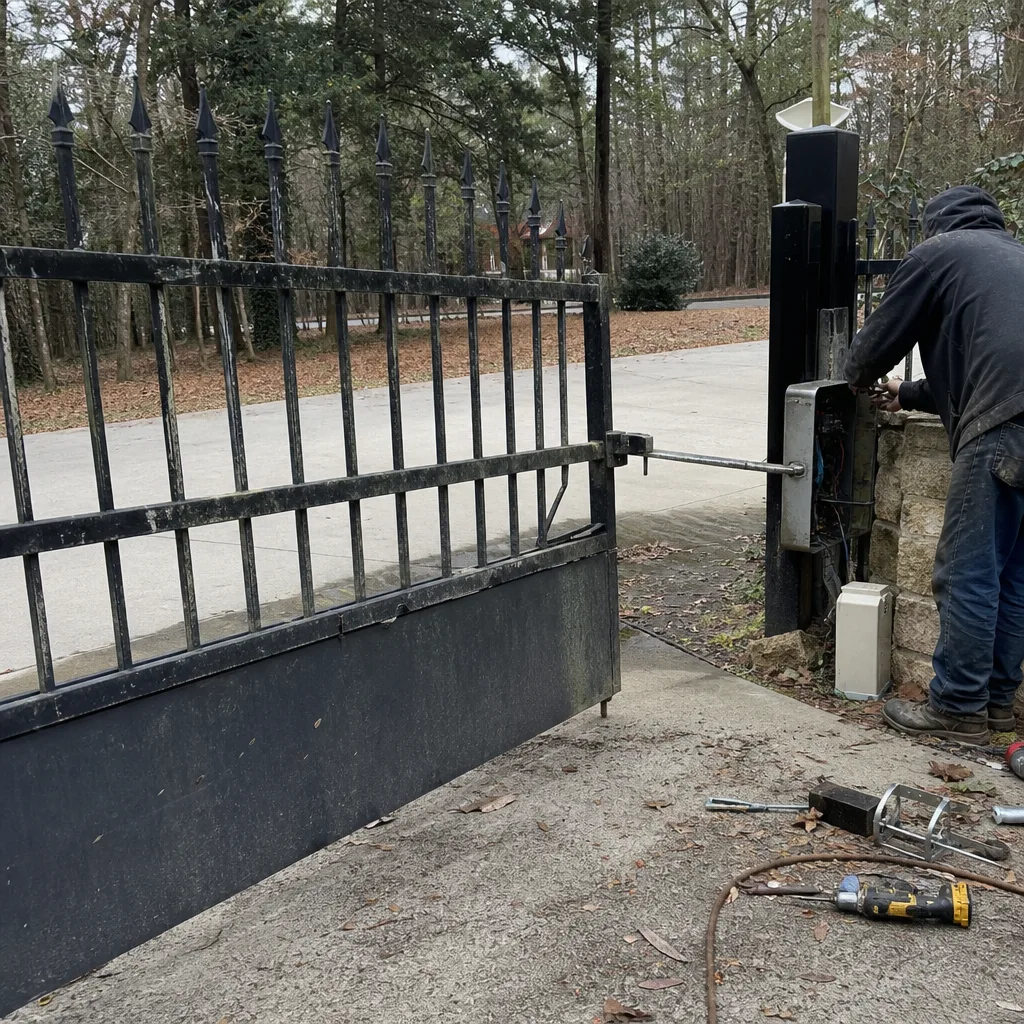 Before
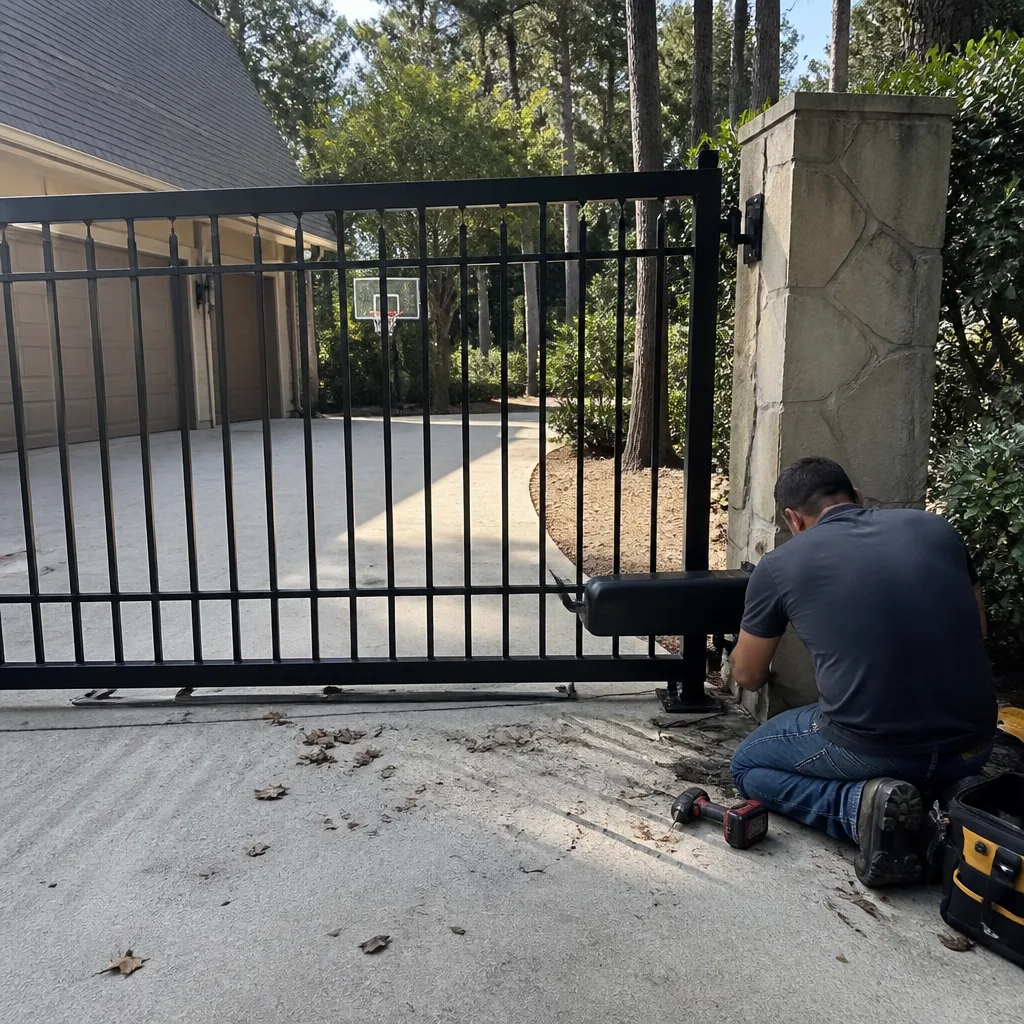 After
After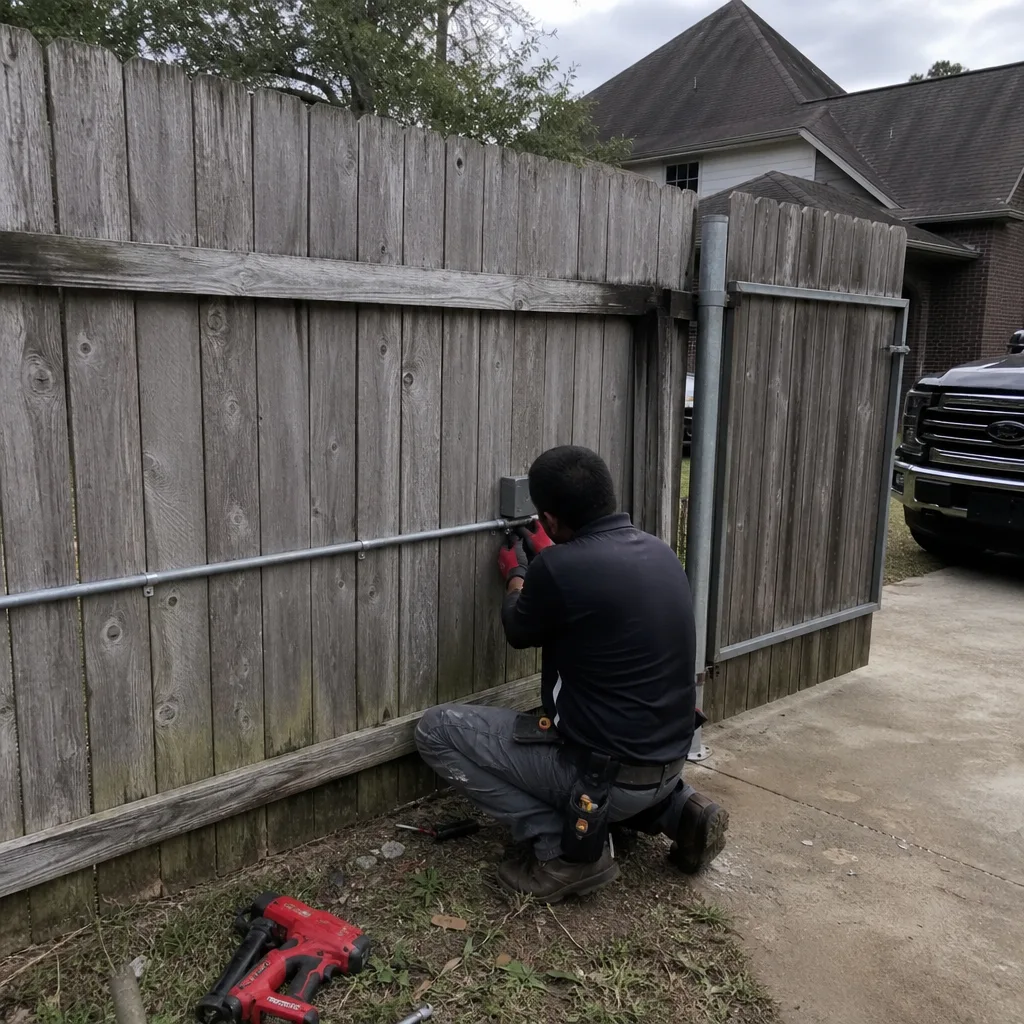 Before
 After
AfterGate Repair Maintenance Checklist for Conroe Homeowners
A gate that fails in Conroe rarely fails by surprise. The hinge that snapped in August was binding in March. The photo-eye that stops responding after a thunderstorm was already fifteen degrees out of alignment before the first drop fell. Maintenance in this climate is not a set of chores. It is a set of readings taken against known thresholds. Most gate failures we see in Conroe begin as a slow drift past a limit that nobody was measuring. This guide gives you the checklist, the pass/fail numbers, and the documentation habit that tells you what changed before you find out the expensive way.
Quick Answer
A meaningful Conroe gate maintenance checklist pairs every visual inspection with a pass/fail threshold tied to this region’s humidity, clay soil, and temperature swings. At minimum, check hinge gap in millimeters, photo-eye alignment in degrees, battery float voltage in volts, chain sag against a ruler, and operator force settings monthly. Document the readings in photos and writing. When any reading moves more than 10 percent from baseline, book Gate Repair services before it becomes an emergency call.
Table of Contents
- Why Conroe’s Climate Changes the Maintenance Rules
- The Monthly Inspection Checklist With Pass/Fail Thresholds
- Wet-Season vs. Dry-Season: What Changes and Why
- The Five Components Most Conroe Owners Skip
- How to Document a Maintenance Visit Yourself
- Monitor-and-Note vs. Fix-Now: Reading Your Findings
- Brand-Specific Maintenance Notes: LiftMaster, FAAC, Mighty Mule, Elite
- Common Mistakes to Avoid
- When to Call a Professional
- Frequently Asked Questions
- The Bottom Line
BeforeAfterWhy Conroe’s Climate Changes the Maintenance Rules
Conroe sits on expansive clay soil in a humid subtropical belt. The ground moves. After a wet spring, clay swells and shifts gate posts by fractions of an inch. After a dry August, the same clay contracts and leaves a hinge post leaning a degree or two outward. A gate that clears its latch plate by half an inch in May may drag by September. No other maintenance variable in Conroe matters more than post movement, because every other adjustment is downstream of it.
Humidity is the second factor. Average relative humidity in Conroe runs above 70 percent most mornings. Condensation forms on cold steel overnight. That moisture attacks bare metal at the hinge barrel, the chain, and any scratch in the powder coat. A lubrication schedule written for a Dallas or Austin gate will leave a Conroe gate under-protected during the wet months and over-lubricated during the dry ones, when dust from Montgomery County clay lanes sticks to wet grease and becomes a grinding paste.
Temperature matters less than people assume. Conroe rarely freezes hard enough to damage a properly adjusted operator, but the swing from a 95-degree afternoon to a 70-degree night causes normal thermal expansion in steel and aluminum. A limit switch set to the exact edge of travel in July will bind slightly in January. Leave margin. We set travel limits with a minimum of 5 millimeters of mechanical buffer at both ends, not because the gate needs it today, but because Conroe’s seasonal range guarantees it will need it eventually.
The maintenance routine that works in Conroe is one that assumes the ground is always slowly moving, the air is usually damp, and the part that fit perfectly last season will not fit exactly the same this season. That assumption changes what you measure and how often you measure it.
The Monthly Inspection Checklist With Pass/Fail Thresholds
Every item below has a number attached. If you cannot produce the number, you have not actually completed the inspection. This is the difference between maintenance theater and maintenance that prevents a failure.
1. Hinge Gap and Post Plumb
What to check: The gap between the gate leaf and the post at both top and bottom hinge areas, plus the vertical angle of each post.
Pass/fail threshold: Hinge gap should be even within 2 millimeters top to bottom. Post plumb should be within 2 degrees of vertical measured on a magnetic level. Any post leaning more than 4 degrees, or any hinge gap that has changed more than 3 millimeters since the last reading, is a fix-now condition.
Why it fails in Conroe: Clay soil movement. A post can move 2 degrees in a single wet-to-dry cycle. Measure, write it down, compare next month.
2. Photo-Eye Alignment
What to check: The infrared beam between the transmitter and receiver posts (or the retroreflective unit on a single post).
Pass/fail threshold: The receiving unit’s alignment LED should stay green when the gate is at rest and through one full open-close cycle. Alignment should be within 5 degrees of center. Beyond that, the beam starts clipping the edge of the receiver lens, which works fine in dry air and fails in heavy rain when the signal scatters.
Why it fails in Conroe: Thunderstorms. A misaligned photo-eye that works in sunshine will fault during the first downpour. If your gate reverses for no visible reason after rain, check the alignment before you change any parts.
3. Battery Float Voltage (DC Operators)
What to check: Voltage across the battery terminals while the operator is plugged in and idle.
Pass/fail threshold: A healthy 12-volt battery floats between 13.2 and 13.8 volts. Anything below 12.6 volts means the battery is not holding charge and the charging circuit may be failing. Anything above 14.2 volts means the charger is overcharging and cooking the battery. Both are fix-now.
Why it fails in Conroe: Heat. Conroe summers push battery compartments well over 110 degrees internally, which shortens sealed lead-acid battery life to 18-24 months in many installations. Most emergency calls we run during July and August are dead batteries that showed no symptom until the first power blink.
4. Chain Sag (Sliding Gates)
What to check: Mid-span deflection on the drive chain.
Pass/fail threshold: Total sag should be between 6 and 12 millimeters at the midpoint. Less than 6 millimeters means over-tensioned, which will eat a gearbox bearing. More than 15 millimeters means the chain can jump a sprocket tooth under load, which usually breaks something immediately.
Why it fails in Conroe: Thermal cycling. A chain perfectly tensioned in January gains slack by July. Adjust tension seasonally, not annually.
5. Operator Force Setting
What to check: The resistance required for the gate to reverse on contact, plus the current draw at startup vs. mid-travel.
Pass/fail threshold: The gate should reverse with no more than 10-15 pounds of resistance at the leading edge. Startup current should not exceed 1.5 times the running current. A startup spike above that means binding somewhere: a hinge, a wheel, a post.
Why it fails in Conroe: Dirt and moisture. Wet clay dust builds up on slide tracks and hinge pins. The operator compensates by pushing harder. The force setting drifts higher until the safety reversal no longer works. We see this on at least three out of ten service calls in Conroe’s newer subdivisions where construction dust is still present.
6. Track Debris and Roller Condition (Sliding Gates)
What to check: Gravel, grass clippings, and clay buildup inside the bottom rail or channel.
Pass/fail threshold: The track should be clear enough to run your finger along the full travel without hitting a mound of packed debris. Rollers should spin freely with no lateral play greater than 1 millimeter.
Why it fails in Conroe: Bermuda grass clippings. In the growing season, a mower near the gate throws clippings into the track weekly. Packed wet clippings turn into a fibrous mat that stalls the operator.
Wet-Season vs. Dry-Season: What Changes and Why
Conroe’s wet season runs roughly March through May and again September through October. The dry season runs June through August and December through February. The same maintenance checklist does not work in both windows because the failure mechanism changes.
Wet-Season Adjustments (March-May, September-October)
- Lubricate more frequently, but with a specific product. Use a dry-film PTFE lubricant on hinge pins and chain. Wet oil gathers moisture and clay dust. A dry film leaves nothing for dirt to stick to. Reapply every 6 weeks during wet season versus every 10-12 weeks in dry season.
- Check the post bases after heavy rain. If water pools at the base of a post for more than 24 hours, the clay is getting saturated and the post will move. Add surface drainage or wait for the post to move, because it will.
- Test the photo-eye during rain, not just during clear weather. Half of the reverse-on-close faults we see are photo-eye misalignment that only manifests when rain attenuates the beam. Run the gate through a full cycle during the next thunderstorm, and watch for a fault.
- Inspect the operator housing seal. Condensation inside the housing causes oxidation on terminals and limit-switch contacts. The housing gasket should be intact and the drain hole at the bottom should be clear. In our documented calls, gate motor and opener service in Conroe often finds a blocked drain hole as the root cause of a water-damaged board.
Dry-Season Adjustments (June-August, December-February)
- Check compound sag on the gate leaf. Dry clay soil pulls moisture out of the ground, posts shift outward, and a long steel gate drops at the latch end. Measure from the top corner of the gate leaf to a fixed point on the post. A change of more than 5 millimeters from the wet-season baseline is a fix-now item.
- Clean, don’t just lubricate. Dry season dust is abrasive. Wipe hinge pins and chains clean before applying any lubricant in June. Adding fresh lube to a dusty chain makes a slurry that cuts through the pins faster than dry running would.
- Watch battery temperature. In July and August, an operator housing in direct sun can reach 120 degrees inside. If the battery is over 3 years old, test float voltage weekly during heat waves. Heat failure on lead-acid batteries is sudden and total.
- Check for grass fire exposure. Dry Bermuda grass against a hot operator or welding on a metal post is a fire vector in Conroe’s dry summers. Keep a 2-foot clear zone around any electrical enclosure, especially if the gate backs onto an undeveloped lot in the Grangerland or Cut and Shoot areas.
The Five Components Most Conroe Owners Skip
These five items account for more than half of the emergency service calls we run in Conroe. None of them appear on the generic maintenance checklists printed on the back of operator manuals, though you can find more guides & resources on our blog. All of them are easy to check if you know where to look.
- The gate stop bracket. Every swing gate has a physical stop that limits travel at the open and closed positions. The stop bolt loosens over time, the gate over-travels by a few degrees each week, and the operator pushes against the bracket instead of the stop. The resulting strain kills gearboxes and bends hinges. Check the stop bolt tightness monthly with a wrench. It takes 20 seconds.
- The ground release mechanism. Most swing operators have a manual release key or handle so the gate can be pushed open when power fails. In Conroe’s humidity, that mechanism seizes. We service at least one per month where the release handle is frozen solid, and the homeowner discovers it during a power outage when the gate is closed and the car is inside. Exercise the release once per quarter and lubricate the shaft with a dry-film product.
- The control board standoff screws. The circuit board inside the operator housing is mounted on plastic standoffs. Vibration from daily cycling works those screws loose. The board then flexes every time the gate operates, which cracks solder joints on the relay terminals, which causes intermittent no-op faults. A technician with a screwdriver checks these in 5 minutes. Most Conroe homeowners never know they exist.
- The loop detector or edge sensor calibration. If your gate has a buried vehicle-detection loop or safety edges on the closing edge, the sensitivity setting is a real number. In sandier soil on the northeast side of Conroe, loop sensitivity drifts as the soil moisture changes. Set it too low and the gate won’t open for a car. Set it too high and it opens for a passing truck. Record the setting, test it monthly, and adjust per the operator’s manual by single increments.
- The rack gear shear pins (sliding gates). Rack-and-pinion sliding gates use small shear pins designed to break if the gate hits an obstruction, protecting the gearbox. They are the cheapest part on the gate and the most neglected. If you have a sliding gate, keep two spare shear pins taped inside the operator housing. The next technician will thank you, and so will your wallet when the gate doesn’t destroy a gearbox over a $3 pin.
How to Document a Maintenance Visit Yourself
A maintenance record that says “checked gate, all good” is worthless three months later when the gate fails and you are trying to figure out what changed. A useful record has numbers, photos, and a place to live. Under our own practice, every visit produces a photo log and a written record of what was found and what was set. You can do the same with a phone and a notebook without spending anything.
What to photograph:
- The hinge gap at both top and bottom hinges, with a ruler or caliper in the frame for scale.
- The operator control board showing the limit-switch positions and any LED status lights.
- The battery with a voltmeter reading visible in the frame.
- The chain midpoint with a ruler showing sag depth.
- The full gate from 10 feet back, straight on, so you can see post lean and leaf sag.
- Any wear pattern you find: a polished spot on the track, a rust line at a weld, a cracked insulator.
What to write down:
- Date and time, outdoor temperature, and whether the ground was wet or dry. Soil moisture affects every measurement that involves post position.
- Every reading from the monthly checklist above, even the pass values. You are logging trends, not just problems.
- Any adjustment you made, however small, and the before value. “Photo-eye: moved 3 degrees left, was 8 degrees off center, now 5 degrees” is a useful note. “Adjusted photo-eye” is not.
- The brand, model, and serial number of every component you touched. Write it once and keep it. Future technician visits go twice as fast when the part numbers are on the page.
Where to store it: A shared note on your phone works. A spiral notebook in the mailbox post works. What matters is that the record lives somewhere that survives a phone upgrade and is accessible to whoever services the gate next. Tape a copy of the last reading sheet inside the operator housing in a zip-lock bag. The next person who opens that housing will know exactly what the gate looked like when it was last healthy.
Monitor-and-Note vs. Fix-Now: Reading Your Findings
Not every anomaly is an emergency. But some anomalies look benign and are not. The difference is whether the deviation is stable or moving, and whether the part in question fails slowly or catastrophically.
Monitor-and-Note Items
- A post that is 2.5 degrees off plumb and has not moved for 6 months. Note it, photograph it, recheck monthly. Some posts move once and stop.
- A battery float voltage at 12.8 volts. It is aging but still viable. Test weekly during summer and replace when it drops below 12.6.
- A chain with 14 millimeters of sag. It is near the top of the range. Check monthly and adjust when it hits 15. (See our gate repair in Conroe page for what a full tension adjustment includes.)
- Light surface rust on a hinge barrel. Wire brush it, coat with a rust converter, and recheck quarterly.
Fix-Now Items
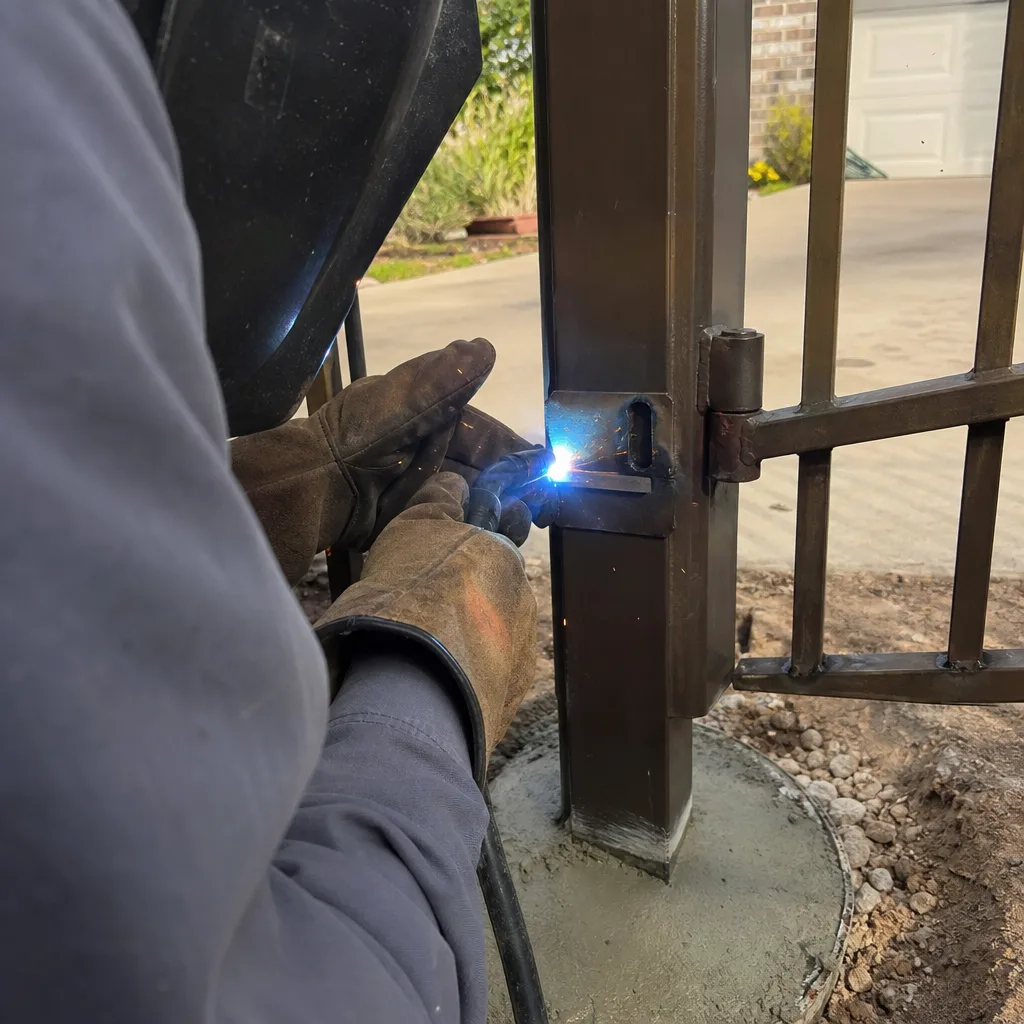
- A hinge gap that changed more than 3 millimeters between readings. The post is moving actively. Every extra week means more load on the hinge pin and the operator.
- A photo-eye that faults during rain. It will not get better, and it will fail permanently during the next heavy storm.
- A battery float voltage of 12.4 volts or below. The battery is dead when it is needed and the backup function no longer exists.
- A stop bracket with a visible gap or movement. The gate is over-traveling and the operator is taking damage on every cycle.
- Any fence section or post with a crack in a weld, especially at a hinge point. A gate that breaks a hinge weld at speed is dangerous to anything in the swing path.
When a gate is genuinely dangerous, do not attempt a repair you are not trained for. A swing gate leaf weighs hundreds of pounds and carries stored energy in the operator chain and the tensioned hinges. If a post is actively moving or a hinge is cracked, leave the gate latched open or secured closed, put a note on it, and call a professional who works on gate installation in Conroe for the same day.
Brand-Specific Maintenance Notes: LiftMaster, FAAC, Mighty Mule, Elite
Each operator brand has specific failure points in Conroe’s conditions. Knowing yours changes what you check first.
LiftMaster
LiftMaster swing and slide operators are common in Conroe’s larger gated properties. The most frequent issue we see is limit-switch drift on the mechanical units, where the switch cam backs off a few degrees each month under vibration. Check the limit-switch screw tightness monthly on older LiftMaster units. On newer logic-board units, the force sensitivity defaults are often set too high from the factory for lightweight residential gates, which masks a binding hinge until the hinge fails. We typically reduce force settings by 20-30 percent on LiftMaster installs in Conroe after measuring the actual load.
FAAC
FAAC hydraulic operators are built for continuous duty, but the oil viscosity changes with Conroe’s heat. In August, the oil thins, the gate moves slightly faster, and the deceleration ramp shifts. Check the pressure bypass setting seasonally. A FAAC gate that closes with a soft thud in January may slam in July if the bypass was never adjusted. The seals also weep more in heat. A dime-sized oil spot on the operator base in August is a note; a palm-sized spot is a rebuild.
Mighty Mule
Mighty Mule is the most common DIY-installed operator we see in Conroe’s acreage communities. The single biggest problem is the control board’s sensitivity to power surges. Montgomery County lightning season runs March through June, and we replace more Mighty Mule boards in those four months than the rest of the year combined. The fix is a surge protector installed at the outlet and a secondary inline fuse on the low-voltage side. Neither comes with the kit. Both cost less than one board.
Elite
Elite slide operators use a machined gearbox that must stay aligned to the rack within 2 millimeters of design height. If a wheel set wears or a post shifts, the gearbox pinion climbs the rack, which loads the output bearing unevenly. Check the pinion-to-rack mesh visually each month. You should see a consistent gap with no polished wear marks on the gear teeth. A polished strip on one side of the gear teeth is the first sign of post movement.
For full operator service records covering all nine brands we maintain, see our gate motor and opener service in Conroe page.
Common Mistakes to Avoid
- Lubricating with WD-40 and calling it done. WD-40 is a water displacer, not a lasting lubricant. It evaporates within weeks in Conroe’s heat. Use a dry-film PTFE or a lithium grease, matched to the application point.
- Checking the gate only when it misbehaves. By the time a gate is binding, the post has been moving for months and the operator has been fighting it. Monthly measurements would have caught the drift.
- Setting the force sensitivity higher to fix a binding gate. That is the most common mistake we see after a DIY repair. The gate now closes through an obstruction rather than reversing. It also wears the operator faster. Find the bind, don’t overpower it.
- Ignoring a photo-eye fault and bypassing the sensor. Bypassing the photo-eye on a residential gate in Conroe is a liability issue as much as a safety issue. Kids, pets, and delivery drivers are in the swing path every day.
- Tensioning a chain without measuring sag. Over-tightening is the leading cause of gearbox bearing failure on sliding gates. Use a ruler, not your thumb.
- Keeping maintenance records in a phone that gets replaced. If the next technician cannot see last year’s readings, the gate’s maintenance history is gone. Paper survives, and a zip-lock bag inside the operator housing survives everything.
- Doing a full maintenance pass once a year and trusting it for the other 11 months. Conroe’s clay soil does not move on an annual schedule. The ground moves after every soaking rain and every August drought. Monthly is the minimum for anything with a number attached to it.
When to Call a Professional
Call a professional when a reading is outside the fix-now thresholds above, when the gate has stopped responding to any input, when you hear a new grinding or popping noise from the operator, or when a post is visibly leaning more than 4 degrees. Do not attempt to tension a chain on a gate that has been binding, and do not open an operator housing that is still under warranty unless you are willing to void it. A gate leaf under tension and a high-output operator are both dangerous when they are faulted.
Vance Gate Repair Conroe offers free estimates in Conroe, with every job documented under the same commercial standard we have used since 2014 and in compliance with Gate Repair Permits, Codes & Inspections in TX: What You Need to Know. Call (936) 297-5126 and a person answers, day or night.
Frequently Asked Questions
Run the full monthly inspection checklist every 30 days, and run the wet-season adjustments during March through May and September through October. Conroe’s clay soil and humidity make a monthly rhythm the minimum viable schedule. Call (936) 297-5126 if you want a second set of eyes on a specific reading.
A standard maintenance visit on a residential swing gate in Conroe typically runs between $150 and $350, depending on the operator brand, the gate length, and whether any parts need replacement. The price is written and agreed before any work starts under Vance’s Haven Standard, and the written quote is yours to keep.
Monthly visual checks, measurements, photo documentation, and lubrication are all within a homeowner’s reach. Leave tensioning, limit adjustment, force calibration, and anything that involves opening the operator housing to a technician unless you are certain of what you are doing.
The most common repair issue we see is post movement from clay soil expansion and contraction, which causes hinge binding, latch misalignment, and operator overload. The second most common is battery failure in summer heat.
Yes. We service nine major automation brands including LiftMaster, FAAC, and Mighty Mule, so the gate you already have gets fixed rather than replaced. The written quote states the brand and model we will service before any work starts.
Run a full cycle and watch for any hesitation, grinding, or reversal. Test the photo-eye alignment during the next rain, not just in dry air. If the gate reverses or faults, secure it in the open or closed position and call (936) 297-5126 for a same-day service visit in Conroe.
The Bottom Line
A Conroe gate fails when a reading drifts past a threshold that no one was tracking. The maintenance that prevents that failure is not more effort; it is more specificity. Measure hinge gap in millimeters, post plumb in degrees, battery voltage in volts, chain sag against a ruler. Document the numbers in photos and writing, and store the record where the next technician can find it. Adjust your lubrication and inspection rhythm seasonally to match Conroe’s wet and dry cycles. When a reading crosses into fix-now territory, call (936) 297-5126, get a written price before any work begins, and get a documented record of what was found and what was corrected. That is the whole system.
Written by Adrian Vance, Owner at Vance Gate Repair Conroe, serving Conroe since 2014.